
Logging a sauna session without an Apple Watch
Contrast works without a watch. Time a session on the iPhone as it happens, or log a past one afterwards: when it started, each round, and the temperatures if you know them. Manual sessions go into Apple Health and into the habit analysis exactly like watch sessions. What they cannot feed are the heart-rate metrics, which need a heart rate.
The automatic detection needs an Apple Watch Ultra or a Series 10 and later. Everything else in Contrast needs an iPhone, and a good deal of the app works with no watch at all.
Two ways to log by hand
Live. Start a session on the iPhone and it runs a timer, with the same Switch control the watch has. Put the phone down outside the sauna, come out, switch to cold, go back. The phone is doing what the watch would do minus the sensor readings.
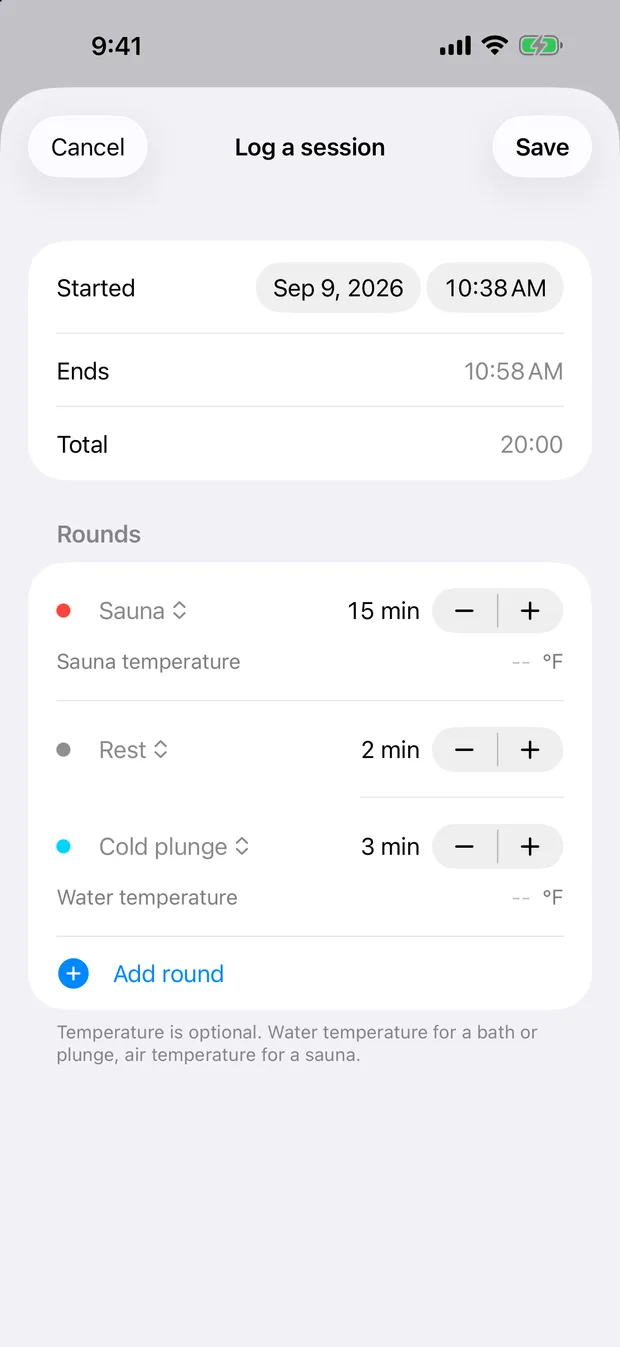
After the fact. Open the log screen and describe a session that already happened: when it started, then each round in order with its modality and its length. Add temperatures if you know them, skip them if you do not.
The second is the one most people use, because the bag with the phone in it is rarely within reach. It takes about twenty seconds for a three-round session.
What a manual session needs
The start time and the rounds. Everything else is optional.
A round is a modality, a phase and a duration. Rest between rounds is a round too — it has its own phase and it is counted, so a session logged as sauna 15, rest 5, plunge 2, rest 5, sauna 12 records 27 minutes of heat, 2 of cold and 10 of rest, and the day ring draws all three.
Temperatures are per round. Type the water temperature for a bath or plunge and the round joins the band chart; leave it blank and the minutes still count towards your weekly cold or heat. For a sauna you can type the air temperature, which is worth doing if you use more than one sauna — the heat strain metric compares saunas within 10 °C of each other and groups them all together when it has no reading.
What a manual session can and cannot feed
This is the honest part, and it splits cleanly along one line: does the metric need heart rate?
| Feature | Works with a manual session? |
|---|---|
| Day, week and month calendar | Yes |
| Apple Health workout | Yes |
| Weekly heat and cold, goal rings | Yes |
| 12 weeks of heat and cold | Yes |
| Sauna and hot bath frequency vs the cohorts | Yes |
| Cold minutes by water band | Only with temperatures entered |
| Sessions and your nights | Yes — it needs a session date, not a heart rate |
| When you do it | Yes |
| Heart work in the heat | No |
| Cold shock, cold settle, heat strain | No |
| Heart rate by water temperature | No |
The pattern is worth stating outright: the habit and timing analysis works fully by hand, and the adaptation analysis does not. Cold shock is the size of the jump in your heart rate when you get in; with no heart rate there is no jump to measure. Nothing is hidden or greyed out to sell you a watch — those cards simply have nothing to draw and say so.
The nights section is the pleasant surprise. It compares your sleep, HRV and next-morning resting heart rate on nights after a session against your other nights, and all of that data comes from Apple Health rather than from the session. What the session supplies is the date. A manual log is a perfectly good date.
The cohort comparison works by hand
The two studies the app sets your habit against both measured self-reported frequency, which is exactly what a manual log is.
The Finnish cohort followed 2,315 men for a median of 20.7 years and grouped them by sessions a week and minutes a session. Against once a week, four to seven sessions went with a lower risk of sudden cardiac death, with a hazard ratio of 0.37 in those men; sessions over 19 minutes went with lower risk than sessions under 11. The Japanese tub-bathing study followed about 30,000 adults for around 20 years and found almost-daily bathing associated with a 28% lower risk of cardiovascular disease than zero to two times a week.
Both are observational, both asked about habits once at the start, and neither shows that sauna or bathing caused the difference — people who bathe more may differ in other ways. Contrast reports which group your last four weeks put you in and repeats those caveats on the metric’s own page.
Your minutes are your minutes whether a sensor counted them or you did.
Free, and staying that way
Manual logging is in the free tier, along with watch tracking, saving to Apple Health, your last seven days of history, your weekly heat and cold set against the research, and the full explanation of every metric.
Contrast Pro adds your full history, the heart rate and water temperature charts, time in each band, heart rate zones, sauna temperature, combining and archiving sessions, and the Analysis tab beyond the weekly amounts.
A phone-only user on the free tier gets a complete log, a calendar, Health integration and the research comparison. That is a real product rather than a demonstration of one.
One habit worth forming
Log the session the same evening. The thing that degrades a hand-written log is not accuracy about minutes — nobody needs that to the second — it is the session you meant to enter on Thursday and entered on Sunday as “about twenty minutes, I think”.
The nights analysis is the reason to care. It compares nights following a session day against nights that did not, and a session attributed to the wrong day moves a night from one side of that comparison to the other. Two or three of those will not matter across six months. A habit of them will.
Common questions
Can I use Contrast without an Apple Watch?
Yes. Time a session on the iPhone as it happens, or log a past one afterwards with its start time, rounds and temperatures. Manual logging is part of the free tier.
Do manual sessions count in the Analysis tab?
The habit section yes, in full — weekly heat and cold, the 12-week chart, the goal rings, and the comparison against the Finnish and Japanese cohorts. The heart-rate metrics cannot use them, because they need heart rate.
Do I have to enter a temperature?
No. Rounds are required, temperatures are optional. A round with no temperature still counts its minutes towards heat or cold; it just contributes nothing to the band chart.
Is manual logging behind Contrast Pro?
No. Watch tracking, saving to Apple Health, logging by hand, your last 7 days of history and your weekly totals set against published research are all free, permanently.