
Sauna, bath, plunge, shower: why only two can be detected
Contrast records four modalities — sauna, bath, plunge and shower — but the Apple Watch water temperature sensor can only classify the two that submerge your wrist. A sauna is dry heat and a shower runs past the wrist without covering it, so both are always picked by hand. Phase and modality are separate fields, which is why a shower can be hot or cold.
Contrast keeps two separate facts about every round: what your body was doing, and how you were doing it. The first is the phase — heat, cold or rest. The second is the modality — sauna, bath, plunge or shower. Keeping them apart is what lets a cold shower and a hot shower both exist without a special case.
The two fields, and why they are two
A phase is the thing the research is about. Studies on sauna and studies on cold water are studies about heat and cold; the container is incidental to the physiology and central to how you describe your evening.
| Phase | Modalities offered |
|---|---|
| Heat | Sauna, bath, shower |
| Cold | Plunge, shower |
| Rest | — |
Shower appears under both, which is the whole reason for the split. Collapse phase and modality into one list and you need two shower entries that behave identically except for a colour. Keep them apart and a shower is one modality that can take either phase, exactly as it works in life.
Rest is its own phase with its own modality, and it is a timed segment rather than a gap between segments. The minutes you spend cooling off between a sauna and a plunge are recorded, coloured grey, and counted in the day ring.
What the sensor can and cannot see
The Apple Watch water temperature sensor reports a temperature, an uncertainty, and a submersion state. The submersion state is a ladder: not submerged, shallow, deep, approaching maximum depth, past maximum depth, plus an unknown and a sensor-error rung.
Submersion is the operative word. A shower puts a great deal of water on your wrist and none around it, which reads as not submerged the entire time. From the sensor’s position, a hot shower and a brisk walk in the rain are the same event.
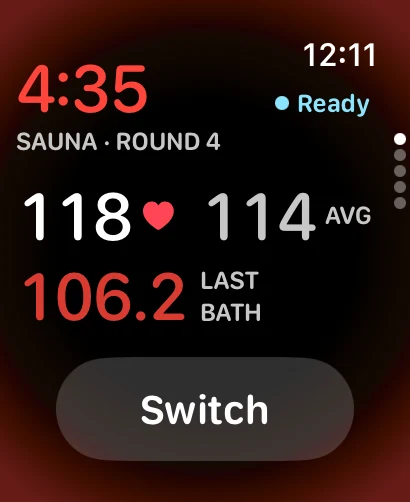
A sauna gives it even less. There is no water at all, so there is no reading to classify, and the app will not invent a water temperature for a room. This is why the watch screen during a sauna round shows the last soak’s temperature in a dimmed colour instead — the row still says something useful, and it is clearly labelled as belonging to a previous round rather than to this one.
What happens when the sensor does fire
When submersion starts a round, the classifier’s temperature reading decides the phase, and the phase implies a modality: cold means plunge, heat means bath. The app picks the immersion modality because it is the only one the sensor could have been reading.
That guess is right almost always and wrong in one common case — someone standing under a cold shower who happens to dunk a hand in something. Correcting it takes one tap in the Switch sheet, and the correction is not cosmetic. It moves the minutes between the plunge and the shower buckets in the weekly totals, changes which comparison group the round falls into for the cold adaptation metrics, and is written back to the copy of the session kept on your iPhone.
Why the distinction matters to the numbers
Three of the app’s metrics only look at specific modalities, and they are strict about it.
Cold shock and cold settle only consider plunges, and only plunges in the same water temperature band as each other. A cold shower has no water reading at all, so it cannot join that comparison; including it would mean comparing a measured 6 °C immersion against an unmeasured stream of something.
Heat strain only looks at the first sauna or hot bath of a session, at least six minutes long, and compares saunas with saunas and baths with baths. Heat at 80 °C in dry air does something different to your heart than 40 °C water at chest depth, and the research says so: in one study, heart rate rose about 60% in a dry 80 °C sauna and about 130% once the air was made humid. A metric that pooled those would be measuring the mix rather than the adaptation.
Sauna sessions and hot baths are compared against different cohorts, because the underlying studies are different. The Finnish work followed men using traditional saunas at about 79 °C. The Japanese tub-bathing study followed roughly 30,000 adults in baths at around 40 to 42 °C. Neither result transfers to the other container, and the app does not pretend it does.
What heat and cold share, and where the app draws the line
For the weekly totals, all heat counts as heat and all cold counts as cold. A sauna minute and a hot bath minute both land in the same weekly heat figure, and a plunge minute and a cold shower minute both land in the weekly cold figure.
The app’s own documentation is explicit that this is a simplification, and it says so in the limits paragraph: heat is counted the same whether it is an 80 °C sauna or a 40 °C bath, though no study sets an exchange rate between them. Nobody has run the trial that would let anyone convert one into the other, so Contrast adds the minutes and tells you that is what it did.
That is the pattern worth noticing across the whole app. Where a distinction has evidence behind it, the metric enforces it. Where it does not, the metric collapses the distinction and names the collapse in its limits.
Practical notes
A sauna’s air temperature is something you can type in, and it is worth doing if you use more than one sauna. Heat strain compares saunas within 10 °C of each other; without a temperature it groups them all together, which is a coarser comparison than it could be.
Water Lock comes on when you get in and stays on until you dismiss it, so a plunge and a bath both protect the screen from splashes. A shower does not trigger it, because the app never knew you were in one.
If you use a cold shower as your only cold exposure, everything in the habit section still works — weekly cold minutes, the 12-week chart, the goal rings. The adaptation metrics will stay empty, and that is the honest outcome: those measures need a water temperature to compare like with like, and a shower does not produce one.
Common questions
Why does my sauna not start automatically?
A sauna is dry heat. The Apple Watch water temperature sensor needs submersion, and nothing in a sauna submerges your wrist, so there is no reading to classify. You pick a sauna round with the Switch button.
Why is a shower not detected either?
A shower wets the wrist but does not submerge it. The sensor reports a submersion state, not a wetness state, so a shower looks the same to it as standing in the rain.
Can a shower be recorded as cold?
Yes. Phase and modality are separate fields in Contrast. A shower can carry either phase, which is why cold shower and hot shower are both real rounds with their own colours.
The app called my cold shower a plunge. How do I fix it?
When the sensor classifies a round it assumes the immersion modality: plunge for cold, bath for heat. Change it in the Switch sheet, and the correction carries through to the analysis and to Apple Health.