
Heart work in the heat, and why it is not calories
Contrast counts the minutes your heart spent at or above 64% of your max heart rate in the heat as moderate, and at or above 77% as vigorous, using the American College of Sports Medicine's exercise intensity bands. It refuses to convert those minutes into calories, because heat raises heart rate by moving blood to the skin rather than by working muscle.
Sit in a hot sauna and your heart rate climbs into a range your watch would call a workout. Contrast counts those minutes and then stops, and the stopping is the considered part.
What is counted
In every sauna and hot bath round, time at or above 64% of your maximum heart rate counts as moderate, and time at or above 77% counts as vigorous. Your max heart rate is whatever you set in Settings under Health and units.
Those two thresholds are the American College of Sports Medicine’s intensity bands, from their 2011 position stand: moderate is 64 to 76% of maximum heart rate, vigorous is 77 to 95%. They are the standard the whole fitness industry uses, which is both why they are here and why they need a warning label.
Which watch, and which sauna
This metric needs heart rate during the round, which means the watch on your wrist in the heat, and Apple puts a limit on that. Its page on Apple Watch water resistance advises against wearing any model other than Apple Watch Ultra in a sauna, and against wearing Ultra in a sauna above 55 °C (130 °F). It also advises against wearing any Apple Watch in a steam room.
A traditional Finnish sauna runs 70–100 °C, above that limit for every model. So in practice this card fills in for an Ultra in a cooler sauna or an infrared cabin, and for hot baths, which run 38–42 °C. With the watch left outside a hot sauna, Contrast still times the round from your tap on Switch, and the round simply has no heart rate.
The heart really does work
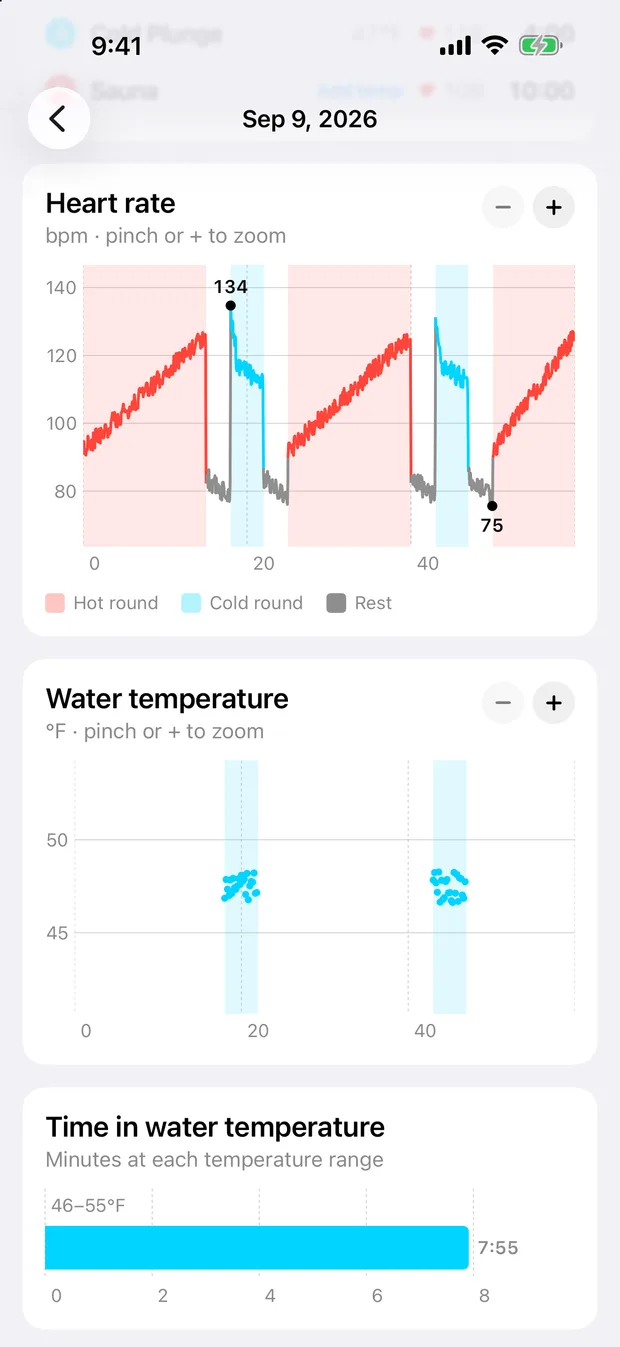
This is not a small effect that has been dressed up. In a study of 19 adults, heart rate and blood pressure during a sauna at 93 °C matched those measured during cycling at 60 to 100 watts. Heart rate in a hot sauna can reach around 150 bpm.
The mechanism is straightforward. To shed heat, the body moves blood to the skin. Skin blood flow can rise several-fold, which drops peripheral resistance, which drops stroke volume, which the heart compensates for by beating faster. Add the fluid you lose sweating and the effect compounds over a long round.
So the cardiovascular load is real and measurable, and the Finnish cohort studies that found associations between sauna use and lower cardiovascular mortality were looking at people doing exactly this, repeatedly, for decades.
Why it is not converted to calories
Every fitness API within reach will take a heart rate series and return an energy estimate. Contrast does not use one, and the reason is in a 2003 review the metric cites directly: heat raises heart rate without raising energy use, so heart-rate-based calorie estimates fail in the heat.
The heart-rate-to-calories conversion rests on an assumption that holds during exercise and fails here. In exercise, heart rate tracks oxygen consumption because muscle is doing work that needs oxygen. In a sauna, heart rate is elevated by thermoregulation — moving blood around — while the muscles are doing nothing. Oxygen consumption barely moves.
Feed a sauna heart rate trace into an exercise formula and you get a number that looks like a workout and describes nothing. Twenty minutes at 140 bpm reported as 250 kcal is not an approximation; it is a category error with a decimal point.
The app’s own limits paragraph says this in one sentence: heart-rate zones were built for exercise, heat raises heart rate by moving blood to the skin rather than by working muscles, so the same zone means something different here. It describes the load on your heart, not fitness.
What “borrowed” means for this metric
Heat load carries the borrowed evidence tier, and the borrowing is specific.
What is established: the ACSM bands as exercise intensity thresholds, and the observation that sauna heart rates reach submaximal-exercise levels.
What is borrowed: applying an exercise intensity scale to a non-exercise stimulus. Nobody has validated that 12 minutes at 70% of max heart rate in a sauna is equivalent to anything in particular. The bands are a familiar ruler being held up against something they were not made for, and the number they produce is a description rather than a dose.
The honest version of what this metric tells you is: your heart spent this long working at a rate that would count as moderate if you had been exercising. That is genuinely informative — it is why the sauna is not a passive activity for someone with a cardiac condition — and it is not a training statistic.
What it is useful for
Comparing your own sessions. A 20-minute round at the top bench and a 20-minute round at the bottom produce very different minute counts, and the difference is the point.
Noticing adaptation, roughly. As you adapt to heat, the same sauna produces a lower heart rate, so the same round yields fewer moderate minutes over time. The heat strain metric measures this properly, with the temperature controlled; this is the coarse version you will see first.
Knowing when to stop. If a round is putting you at 85% of your maximum heart rate, that is information, and it is the kind of information the app declines to editorialise about beyond showing it.
What moves it that has nothing to do with heat
Your max heart rate setting, first of all. If it is an age-based estimate rather than a measured figure, every percentage on this card inherits that error. Tanaka and colleagues found the 220-minus-age formula both biased and imprecise, with a standard deviation of around 10 bpm between individuals — enough to move a round across a band boundary.
Then: hydration, caffeine, alcohol, a meal, a workout beforehand, how high you sat, and the humidity. In one Finnish study at 80 °C, heart rate rose about 60% in dry air and about 130% once the air was made humid. Same room, same temperature reading, roughly double the response.
None of that is measured. It is the reason this card is a description of one session rather than a trend you should read across months.
Common questions
Does Contrast count sauna as exercise?
No. It counts the minutes your heart worked at an exercise-like level and shows them apart from exercise, because the heart works while the body uses far less oxygen than it would in exercise.
Why does Contrast not show calories burned in a sauna?
Because heat raises heart rate by moving blood to the skin rather than by working muscle, so heart-rate-based energy estimates fail in the heat. The app cites the review that establishes this and reports minutes instead.
What heart rates do the bands use?
The ACSM intensity bands: moderate is 64 to 76% of maximum heart rate, vigorous is 77 to 95%. Your max heart rate is the one set in Settings under Health and units.
How hard does the heart actually work in a sauna?
In one study of 19 adults, heart rate and blood pressure in a 93 °C sauna matched those during cycling at 60 to 100 W. Heart rate can reach around 150 bpm in a hot sauna.
Sources
- Garber CE, Blissmer B, Deschenes MR, et al. ACSM position stand: quantity and quality of exercise. Medicine & Science in Sports & Exercise, 2011.
- Ketelhut S, Ketelhut RG. The blood pressure and heart rate during sauna bath correspond to cardiac responses during submaximal dynamic exercise. Complementary Therapies in Medicine, 2019.
- Achten J, Jeukendrup AE. Heart rate monitoring: applications and limitations. Sports Medicine, 2003.
- Kukkonen-Harjula K, Oja P, Laustiola K, et al. Haemodynamic and hormonal responses to heat exposure in a Finnish sauna bath. European Journal of Applied Physiology, 1989.
- Tanaka H, Monahan KD, Seals DR. Age-predicted maximal heart rate revisited. Journal of the American College of Cardiology, 2001.
- Apple Support: About Apple Watch water resistance (published 14 September 2026)