
Sessions and your nights: what the comparison actually compares
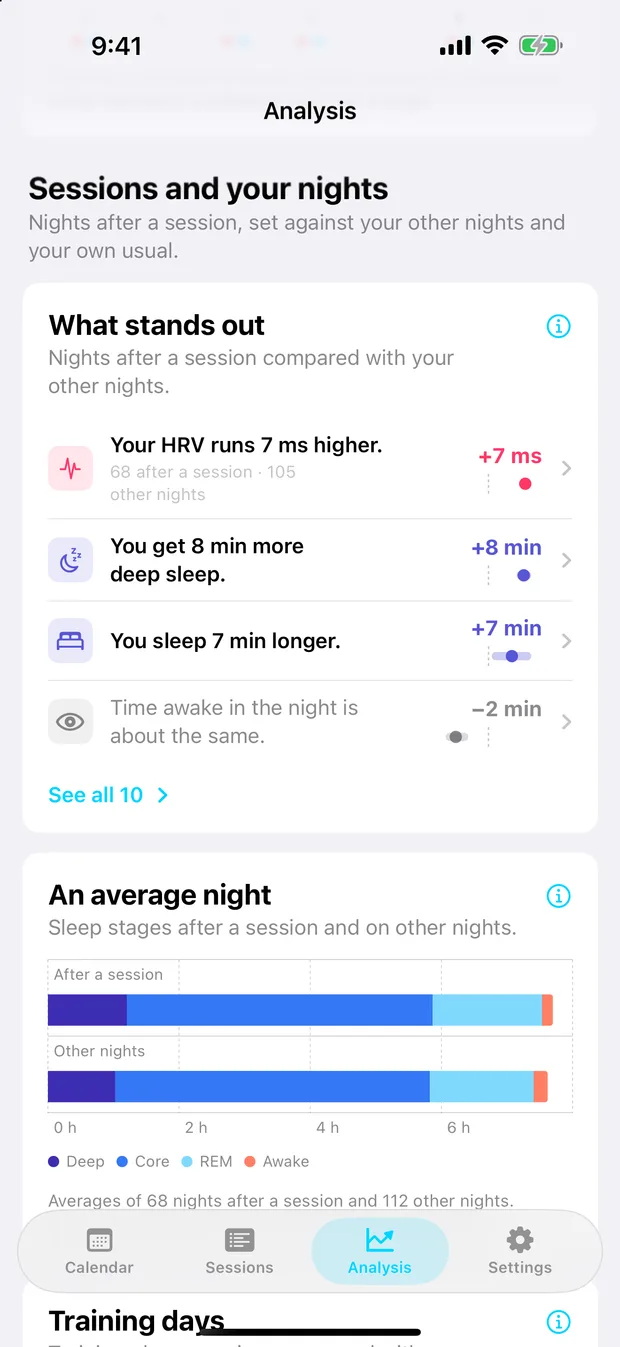
Contrast compares your sleep, HRV, breathing rate, wrist temperature and next-morning resting heart rate on nights after a session against your other nights. Each night is first set against your own median for the preceding 4 weeks, so a slow change over months does not read as a session effect. The comparison is resampled 1,000 times for a 90% interval and needs 5 nights on each side.
The obvious version of this analysis is easy and wrong: average your HRV on nights after a session, average it on other nights, subtract. Contrast does something more careful, and the extra steps are the reason the answer is worth anything.
The measures
Five things, all read from Apple Health: sleep duration and stages, HRV, breathing rate, wrist temperature, and the next morning’s resting heart rate.
HRV here is Apple Watch’s SDNN during sleep. Higher usually means more rest-and-recover activity, and it varies enormously between people — which is why only your own comparison means anything, and why a number from someone else’s watch is not a target.
Step one: each night against your own recent normal
Before anything is compared, each night is expressed as a deviation from your own median for that measure over the preceding four weeks, requiring at least seven nights in that window.
This is the step that does the most work, and it defends against a specific and very common error.
Suppose you start plunging in January and keep it up. Suppose also that you get fitter over those months, or that your resting heart rate falls as winter turns to spring — which it does, seasonally, for most people. Your sessions are concentrated in the later part of the period. A naive comparison would attribute the whole seasonal and fitness drift to the sessions, because the session nights happen to be the later nights.
Measuring each night against the four weeks before it removes almost all of that. A night is good or bad relative to where you were that month, not relative to where you were in January.
Step two: the comparison, and the interval
Nights following a session day are then compared with your other nights, over the last six months, with at least five nights on each side.
The difference between the two groups is resampled 1,000 times — a bootstrap. Repeatedly draw a new sample of the same size from your own nights, with replacement, recompute the difference, and see how much it moves. The middle 90% of those recomputed differences is the range the true difference likely falls in.
The bootstrap earns its place here because the distributions are small, skewed and not normal. Sleep stage minutes have a floor at zero and a long right tail. A textbook interval assuming normality would give a tidy answer to the wrong question.
Step three: the verdict, including the boring one
The app calls a difference clear only when two things hold: the interval excludes zero, and the effect is large enough to notice.
Both conditions matter. An interval that excludes zero says the difference is probably not nothing; it says nothing about whether it is worth caring about. With enough nights you can establish a genuine 0.4 ms HRV difference, and 0.4 ms is not a fact about your life.
When the whole interval is too small to matter, the app says about the same. That is the result you should expect most often, and it is a real finding rather than a failure. A tool that never says “no difference” is a tool that is not really measuring.
One source per measure
Sleep comes from a single source throughout — whichever has the most complete nights that record stages. HRV and breathing rate come from the source with the most readings.
If you wear a ring some nights and a watch on others, the app picks one and uses it consistently rather than mixing. Two devices disagree systematically about sleep stages, and a comparison built from a mixture would be partly measuring which device you wore.
The breakdowns
Beyond the overall comparison, the app splits the same analysis several ways:
- hot and cold together, against heat only and cold only
- evening sessions, ending within three hours of falling asleep, against earlier ones
- sessions ending on cold against sessions ending on heat
- on days with a workout of 20 minutes or more, training plus a session against training alone
Each of those is a separate comparison with its own five-nights-a-side requirement, so most will be empty for a while. The training split is the most interesting one to wait for, because it is the closest this data can get to holding something constant.
What the research says about the same measures
The app cites four studies here, and all four describe the drug-free equivalent of a mechanism rather than a result you should expect.
A meta-analysis of before-bedtime passive body heating found that a warm bath or shower at 40 to 42.5 °C, one to two hours before bed, shortened the time taken to fall asleep and improved self-rated sleep quality. Cold water after exercise brought parasympathetic heart activity back faster than passive recovery. A 2025 meta-analysis across studies using water of 15 °C or colder found lower stress 12 hours after immersion and improved sleep quality, with a short-lived rise in inflammation.
Those describe the people in those studies. Your own comparison describes you, and the two are different kinds of statement.
The limits, stated as the app states them
It shows association, not cause. Sessions come on days that differ in other ways: training, stress, alcohol, travel, the day of the week. Wrist sleep stages are estimates rather than measurements. Results change as nights are added, especially early on — a comparison built on five nights a side will move, sometimes a lot, as it reaches thirty.
The honest way to read the whole section is as a question with a decent amount of evidence behind it, rather than an answer. If it says your deep sleep is 14 minutes higher after sessions with an interval from 4 to 24 minutes across 31 nights, what you have learned is that something worth another month of looking is going on.
Common questions
How does Contrast compare nights after a session?
Each night is first set against your own median for that measure over the preceding 4 weeks, needing at least 7 nights. Nights after a session day are then compared with your other nights over the last 6 months, and the difference is resampled 1,000 times to find a 90% range.
Why compare each night to my own recent median first?
It removes slow drift. Without it, getting fitter over six months, or a season turning, would show up as an effect of sessions simply because your sessions are not evenly spread across those months.
What does “about the same” mean?
The whole likely range of the difference is too small to matter. That is a real result rather than a missing one, and most of the comparisons on the page will say it.
Does this prove sauna improves my sleep?
No. It shows what goes together for you, not what causes what. Session days differ from other days in other ways, such as training, stress, alcohol, travel and the day of the week, and this comparison cannot separate those.
Sources
- Haghayegh S, Khoshnevis S, Smolensky MH, Diller KR, Castriotta RJ. Before-bedtime passive body heating by warm shower or bath to improve sleep: a systematic review and meta-analysis. Sleep Medicine Reviews, 2019.
- Buchheit M, Peiffer JJ, Abbiss CR, Laursen PB. Effect of cold water immersion on postexercise parasympathetic reactivation. American Journal of Physiology: Heart and Circulatory Physiology, 2009.
- Cain T, Brinsley JH, Bennett H, et al. Effects of cold-water immersion on health and wellbeing: a systematic review and meta-analysis. PLoS One, 2025.
- Shaffer F, Ginsberg JP. An overview of heart rate variability metrics and norms. Frontiers in Public Health, 2017.