
What the Analysis tab does, and what it refuses to do
The Analysis tab has six sections: this week, sessions and your nights, when you do it, over the months, how your body is adapting, and your habit. It documents fourteen metrics with forty citations, grades its own confidence in four tiers, and deliberately produces no composite readiness score — because a number you cannot decompose is a number you cannot check.
Most of what an app can tell you about sauna and cold water is a description of your own behaviour. Some of it can be set against published research. A little of it is the app’s own invention. The Analysis tab is organised around keeping those three apart and saying which is which.
The six sections
This week is the goal rings: minutes of heat and minutes of cold against the target you picked, with a 12-week chart underneath.
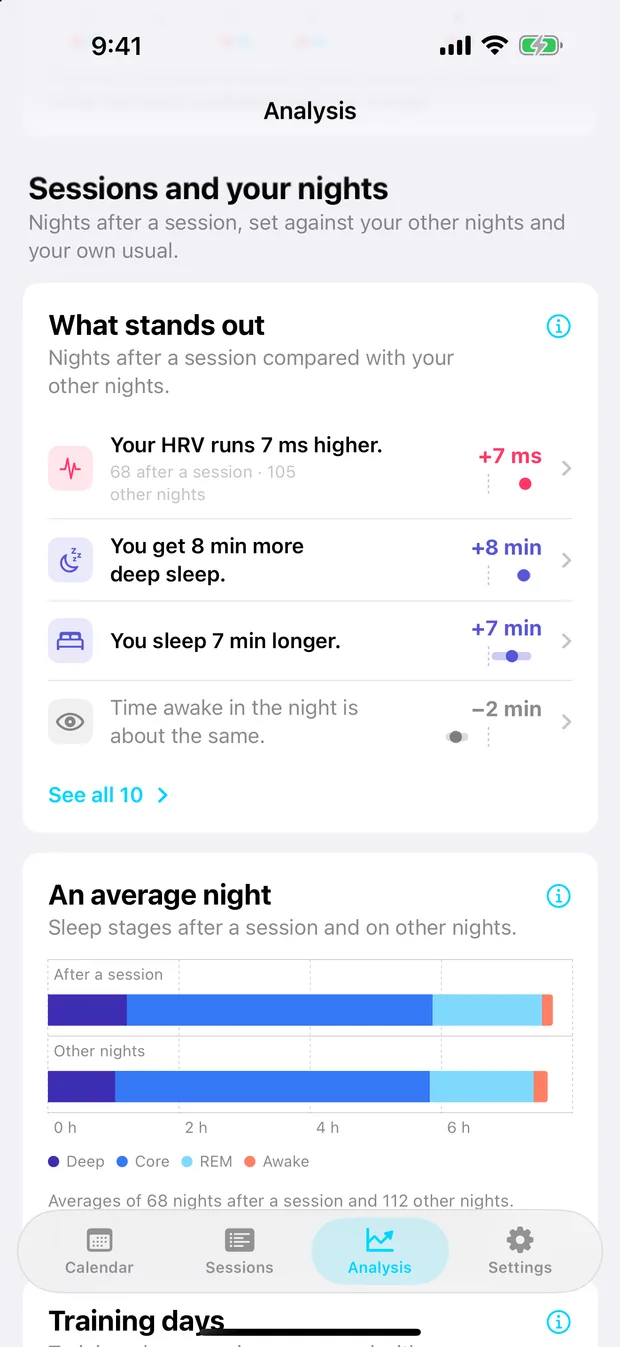
Sessions and your nights compares your sleep, HRV, breathing rate, wrist temperature and next-morning resting heart rate on nights after a session against your other nights.
When you do it is a 24-hour clock of when your sessions start, and what came before them — waking, a workout, or bed.
Over the months plots 26 weeks of session counts beside weekly HRV, resting heart rate and VO₂ max from Apple Health.
How your body is adapting holds the four measures that change as you get used to heat and cold: cold shock, cold settle, heat strain and a heat adaptation estimate, plus a scatter of settled heart rate against water temperature.
Your habit is the weekly amounts and the comparison against the long-term cohort studies.
The order is not arbitrary. It runs from what you did this week, through what your body did afterwards, to what has changed over months — and the research comparisons sit at the end, because they are the least personal thing on the page.
Fourteen metrics, four labels
Every metric carries a documentation page with five parts: what it is, how it is measured, how to read it, what it cannot tell you, and its sources. It also carries one of four evidence labels, and those labels are the most useful thing on the tab.
| Tier | Count | What it means |
|---|---|---|
| Established | 4 | Measured the same way in published research, with results you can compare against |
| Borrowed | 5 | Based on research into a closely related measure, applied here to sauna and cold |
| Theoretical | 2 | Contrast’s own measure, resting on known physiology but untested in a study |
| Your data | 3 | A description of your own sessions and Health data |
Five of fourteen say the measure is either unvalidated or purely descriptive. Forty peer-reviewed citations ship inside the app, each with its population and its finding written out so you do not have to open the paper to know why it is there.
A metric labelled theoretical is not a weaker product. It is a measure someone thought was worth computing and was unwilling to dress up.
How a difference gets called real
The nights section is the statistically serious part of the app, and its method is worth understanding because it governs every comparison on the page.
Each night is set against your own median for that measure over the preceding four weeks, needing at least seven nights. That baseline is what stops a slow change over months — getting fitter, a season turning — from reading as an effect of sessions.
Nights after a session day are then compared with your other nights across the last six months. The difference is resampled 1,000 times to find the range it likely falls in, at 90%. Each comparison needs at least five nights on each side.
The result is called clear only when that interval excludes zero and the effect is large enough to notice. When the whole interval is too small to matter, the app says about the same — which is a real answer, and one most wellness software declines to give.
Sleep comes from a single source throughout, the one with the most complete nights that records stages, and HRV and breathing rate from the source with the most readings. A ring and a watch never get mixed into one series.
What it will not do
No composite score. There is no readiness number, no recovery percentage, no single figure that goes up and down. Compositing hides which input moved, and a number you cannot decompose is a number you cannot check or act on.
No calories for the heat. Heart rate in a hot sauna reaches exercise levels, and every fitness API in reach will convert that into calories. Contrast refuses, because heat raises heart rate by moving blood to the skin rather than by working muscle, and the app cites the paper that says heart-rate-based energy estimates fail in the heat. It reports the minutes at moderate and vigorous heart rate and stops.
No claim of cause. The three descriptive metrics all carry the same sentence: it shows what goes together for you, not what causes what. Sessions happen on days that differ in other ways — training, stress, alcohol, travel, the day of the week — and the analysis cannot separate those.
No prescription. The weekly goal presets are named after the studies they come from, and the app calls them starting points rather than prescriptions.
What it needs from you
The habit section needs sessions. The nights section needs Apple Health sleep data and enough of it: at least seven nights for a baseline, five nights on each side of a comparison, and it improves considerably past about a month. The adaptation metrics need heart rate, which means a watch. The heat strain metric additionally needs a daily resting heart rate from Health.
Cards with nothing to draw say so rather than showing an empty axis. Nothing is greyed out to advertise a feature.
Where to start
Read the habit section first, because it works from day one and needs nothing but sessions. Come back to the nights section after a month, when it has enough data to say anything. Leave the adaptation metrics until you have ten or fifteen plunges in the same water band — they compare your first three against your latest three, and with five plunges those are nearly the same three.
Common questions
What is in the Contrast Analysis tab?
Six sections: this week's heat and cold against your goal, sessions and your nights, when you do it, over the months, how your body is adapting, and your habit set against long-term research. Fourteen metrics in total, each documented.
Does Contrast give a recovery or readiness score?
No, deliberately. A single composite number hides which input moved it, so you cannot check it or act on it. Contrast reports the inputs separately.
How does Contrast decide a difference is real?
It resamples the difference 1,000 times to get a 90% interval and calls the result clear only when that interval excludes zero and the effect is large enough to notice. When the whole interval is too small to matter it says about the same.
Do archived sessions count in the analysis?
No. Archiving removes a session from Analysis, from the weekly goal and from the coach. It stays in Apple Health.