
When you do it: the session clock and what comes before
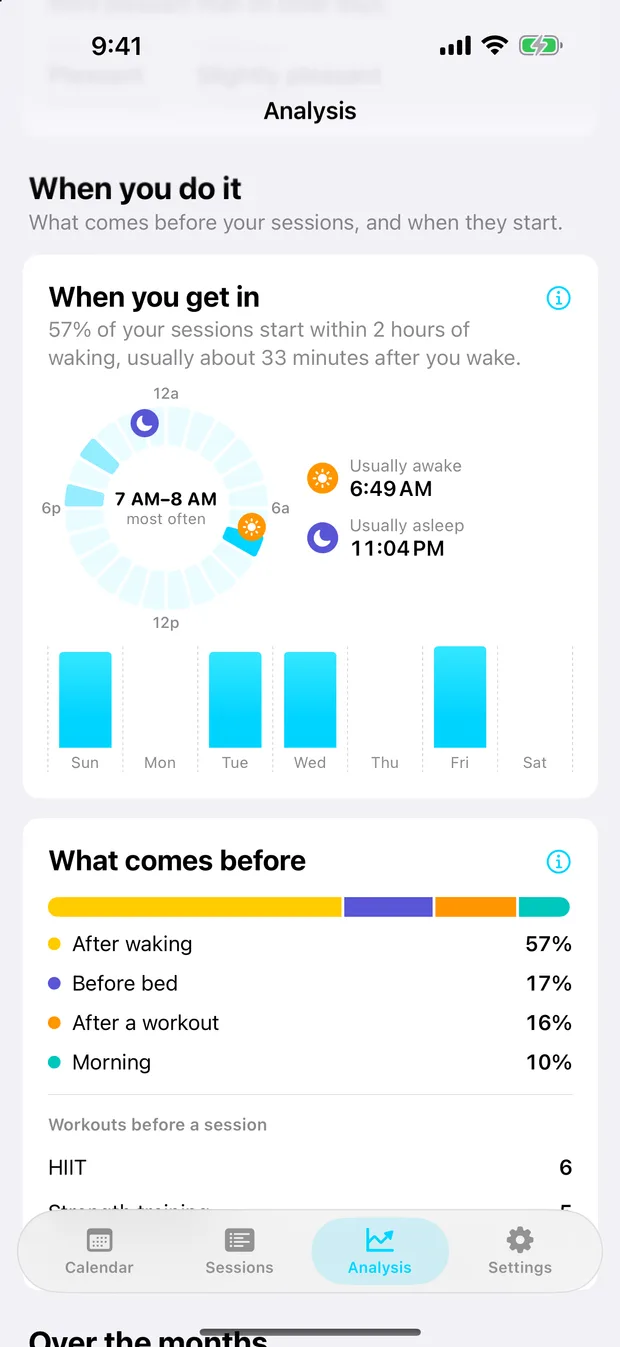
Contrast sorts every session by what came before it: after a workout if it starts within 2 hours of one, after waking if within 2 hours of getting up, before bed if it ends within 3 hours of falling asleep, and otherwise by time of day. The clock shows how often you start in each hour against your own usual wake and sleep times over the last 60 nights.
Most people’s sessions cluster in two or three windows and they cannot tell you which. This section draws the clock.
The clock
A 24-hour dial with a mark for each hour showing how often your sessions start in it, and your own usual wake and sleep times over the last 60 nights drawn on the same face.
Those wake and sleep markers are what make it readable. “Most of my sessions start at 7pm” means something different for someone who sleeps at 10 and someone who sleeps at 1.
The five categories, and the order they are tested in
Every session falls into exactly one bucket, and the order of the tests matters because a session can satisfy several.
- After a workout — starts within 2 hours of a workout of 10 minutes or more. This test runs first.
- After waking — starts within 2 hours of when you woke up.
- Before bed — ends within 3 hours of when you fell asleep.
- Otherwise: morning, afternoon or evening by the clock.
Workout-first is a deliberate choice. A 7am sauna after a 6am gym session is both “after waking” and “after a workout”, and the workout is far more likely to be the thing that matters — it changes your heart rate, your core temperature and your recovery state in ways that waking up does not.
Workouts come from anywhere that writes to Apple Health, so a run recorded by another app counts. The 10-minute floor keeps a stray one-minute stand-alone workout from capturing a session.
What each category needs
| Category | Needs |
|---|---|
| After a workout | Workouts in Apple Health |
| After waking | Apple Health sleep data |
| Before bed | Apple Health sleep data |
| Morning / afternoon / evening | Nothing beyond the session |
Without sleep data the first three are empty and the last three still work. That is a real degradation rather than a hidden failure, and the section says which groups it could not compute.
Why three hours is the bedtime window
The passive body heating literature is the reason. A meta-analysis of warm baths and showers before bed found that water-based heating at 40 to 42.5 °C, one to two hours before bed, shortened the time taken to fall asleep and improved self-rated sleep quality.
The proposed mechanism is the rebound: warming the skin drives blood to the periphery, and the subsequent fall in core temperature is one of the signals that accompanies sleep onset. Three hours is wide enough to contain the one-to-two-hour window with room on either side for a session that ran long.
That study describes warm baths in the people it studied. It does not establish that your evening sauna will do the same thing to you, which is what the nights section is for — it runs a separate comparison of evening sessions against earlier ones, using your own data.
What this section is and is not
It is a description of your routine. The metric’s own reading line says exactly that, and suggests pairing it with Sessions and your nights.
That pairing is the useful move. On its own, “62% of my sessions are before bed” is trivia. Set beside “on evening sessions my deep sleep is 9 minutes higher, likely 1 to 18, across 22 nights”, it becomes something you could act on.
The pairing also exposes the sampling problem that runs through the whole tab. If almost all your sessions are evening sessions, the evening-versus-earlier comparison has almost nothing on one side and will stay empty or wide for a long time. A routine that never varies produces a log that cannot answer questions about variation.
The mildly uncomfortable use
The clock is good at showing you a habit you did not know you had. Two patterns come up often enough to name.
The first is drift: sessions that used to start at 6pm now starting at 9, gradually, over months. Nothing about the weekly totals reveals that, because the minutes are unchanged.
The second is the split week. Weekday sessions at one time and weekend sessions at another is extremely common, and it quietly weakens every comparison the app makes — because weekday and weekend nights differ in sleep, alcohol and stress for reasons that have nothing to do with a sauna.
Neither is a problem the app can fix. Both are worth knowing before you read a difference and attribute it to heat.
Common questions
How does Contrast decide a session came after a workout?
A session starting within 2 hours of a workout of 10 minutes or more, from any app that saves workouts to Apple Health, counts as after a workout. That test runs first, before the waking and bedtime tests.
What counts as a session before bed?
One ending within 3 hours of when you fell asleep, using your Apple Health sleep data. A session starting within 2 hours of waking counts as after waking.
What if I have no sleep data?
The waking and bedtime groups need it and will be empty without it. The workout group needs workouts saved to Apple Health. The plain morning, afternoon and evening groups always work.
Does this tell me the best time to use a sauna?
No. It is a description of your routine. Pair it with Sessions and your nights, which compares evening sessions against earlier ones, to see whether timing makes a difference for you.
Sources
- Haghayegh S, Khoshnevis S, Smolensky MH, Diller KR, Castriotta RJ. Before-bedtime passive body heating by warm shower or bath to improve sleep: a systematic review and meta-analysis. Sleep Medicine Reviews, 2019.
- Fullagar HHK, Skorski S, Duffield R, Hammes D, Coutts AJ, Meyer T. Sleep and athletic performance. Sports Medicine, 2015.